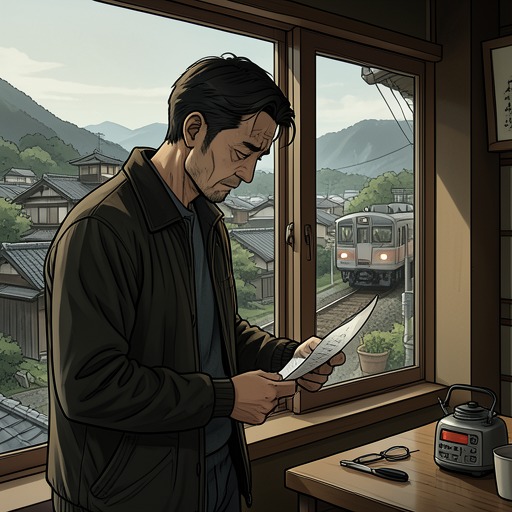
Learning the Family Will Leave Japan
The Character of RainLearning the Family Will Leave Japan is the moment when a future posting becomes, for the Narrator, a catastrophe of belonging and loss. Mother tells her that the family will leave Japan and that Nishio-san will not accompany them. The child hears more than a change of residence: she hears that the garden of her known world has an end, and that love offers no guarantee of permanence.
The Announcement and Its Immediate Stakes
The news comes after Nishio-san has been called to speak privately with Father. The Narrator remains in Mother’s arms, crying and repeating that Nishio-san has to stay with her. Mother gently explains that, whatever happens, the Narrator will one day leave Nishio-san. She adds that Father will not remain in Japan forever: in a year, two years, or three, he will be posted somewhere else, and Nishio-san will not be coming with the family. The departure is thus presented as certain in outline but uncertain in timing. Neither the destination nor the date is known.
That uncertainty gives the announcement its particular force. The child asks whether the family will always stay there and learns that it will not; she asks where they will go, but there is no answer. Asked when, Mother says they do not know. The adults can describe the structure of the future—another posting, a departure, separation from Nishio-san—without supplying the detail the Narrator needs to make it imaginable. Each answer closes off permanence while leaving the replacement world indistinct.
A Child’s Refusal of Departure
The Narrator’s first response is not to negotiate a destination but to deny that leaving is possible. She insists that she cannot leave and must live there. When Mother asks whether she no longer wants to live with her family, the child answers that she does, but that her parents must stay in Japan too. The contradiction exposes the actual demand beneath her protest: not separation from her parents, but preservation of the entire world in which her family, Nishio-san, and home belong together.
When Mother laughs, the Narrator cries harder and asks whether she was being teased, hoping the announcement can still be withdrawn. Mother confirms that the family will leave Japan one day. The child then claims Japan as her country and the house as her own, only to be told that Japan is not her country. The correction sharpens the conflict. What the Narrator experiences as a birthright of familiarity is, in the adult account, temporary residence. Her certainty of belonging meets the family’s diplomatic mobility, which can relocate the household regardless of the child’s attachment.
Her declaration that she will die if she leaves is not treated as a prediction of literal death by Mother, who reassures her that she will not. But the Narrator’s response registers the scale of what she believes is at stake: she describes herself as lost at sea, with the waters rising and no foothold in sight. The image makes the impending move feel less like travel than the disappearance of the ground that has allowed her to exist securely.
From Separation to a Principle of Loss
The Narrator later distinguishes the emotional knowledge delivered by this conversation from the ordinary knowledge that everyone will someday die. At three, she says, death is too distant to mean much. Being told that she will be expelled from the garden within one, two, or three years, without having disobeyed anyone, is more immediate and cruel. The impending departure is therefore an early lesson in loss before wrongdoing: there is no misbehavior to correct and no bargain by which the child can keep what she loves.
This is where the Narrator formulates the principle that will shape her account of childhood and the years beyond it: That which is given you will be taken back. The losses she names include Japan, the mountain, the flowers, the house, Nishio-san, and the language. Their accumulation matters. The threatened departure gathers place, intimate companionship, the natural surroundings, and speech into one threatened world; leaving means losing not a single possession but a whole arrangement of life. The Narrator also anticipates that later consolation cannot restore what is gone. Another home or another person may be offered, but substitution is not recovery.
Narrative Significance
The episode turns an ordinary fact of a diplomat’s family life into the origin point of a recurring conviction. Father’s future reassignment makes departure a practical possibility, but the decisive event is the child’s discovery that a beloved home is temporary even when she has done nothing to deserve its loss. The mother’s reassurance that she will not literally die cannot answer this deeper injury. In the Narrator’s retrospective telling, she had, in a way, already died: the secure assumption that her world would remain intact has ended.
The scene also gives form to the Narrator’s changing understanding of time. The adults speak in a range of one, two, or three years, an interval they cannot narrow; the child receives it as an approaching eviction from paradise. The event’s remembered force lies in that disparity between a postponed move and an immediate emotional rupture. Her final howling gives the announcement no resolution. The family has not yet left, and the date remains unknown, but the loss has already begun as knowledge: what is loved can be taken away, and innocence offers no exemption.